
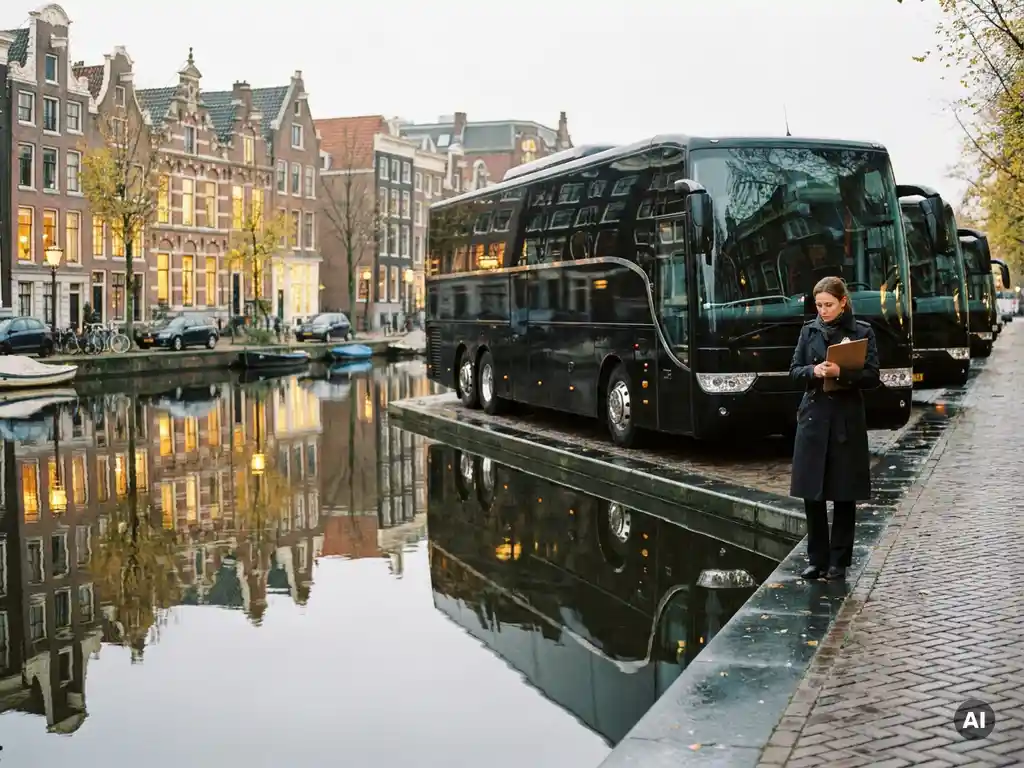
Transport hiccups are one of the most disruptive things that can happen during a large corporate event. A delayed coach, a no-show transfer company, or a sudden road closure can cascade quickly through a carefully planned schedule, leaving dozens or even hundreds of guests stranded and frustrated. The good news is that with a clear response plan, most transport problems can be contained before they escalate into a full crisis.
This guide walks you through exactly what to do when something goes wrong with transport logistics for a large corporate group in the Netherlands, from the moment you spot the problem to the steps you take to make sure it never happens again.
Assess the scope and urgency of the transport issue
Start by gathering the facts before you make any decisions. Reacting too quickly on incomplete information often creates secondary problems, so spend the first few minutes building a clear picture of what is actually happening.
- Identify how many people are affected and where they currently are.
- Determine the cause of the problem: vehicle breakdown, traffic disruption, supplier no-show, or something else.
- Establish the time window you are working with before the delay becomes critical to your program schedule.
- Confirm which upcoming agenda items are directly at risk if the transport issue is not resolved within the next 30 to 60 minutes.
Once you have these four data points, you can categorize the situation as either a minor delay that can be absorbed or a genuine emergency requiring immediate escalation. This distinction shapes every decision that follows. A group of 20 people delayed by 15 minutes is manageable; 150 guests missing a conference opening are not. Knowing the difference early saves time and prevents overreaction.
Activate your backup transport options in the Netherlands
The Netherlands has a well-developed transport infrastructure, which works in your favor when you need to pivot fast. Major cities like Amsterdam, Rotterdam, The Hague, and Utrecht are served by reliable taxi platforms, private transfer companies, and public transit networks that can absorb overflow at short notice.
Contact your backup providers immediately and be specific about what you need. Give them the pickup location, the number of passengers, the destination, and your required arrival time. Vague requests slow down the process. If your original supplier is partially functional, for example, three out of five coaches are still operational, coordinate a phased departure rather than waiting for a full replacement fleet.
- Use platform-based ride services for smaller subgroups of 10 or fewer people when speed matters more than cohesion.
- Contact your hotel concierge or venue coordinator, as they often have direct lines to local transport providers not available through standard channels.
- For intercity transfers, the Dutch rail network (NS) runs frequent services between major cities and can serve as a reliable emergency fallback.
Verify that your backup solution is confirmed and en route before moving on. Do not assume a verbal agreement means a vehicle has been dispatched.
Communicate changes to the group without causing confusion
With your backup transport activated, the next step is getting accurate information to your group as quickly and calmly as possible. Poor communication during a transport disruption is often what turns a manageable delay into a chaotic experience for guests.
- Designate a single point of contact who will send all group communications. Mixed messages from multiple team members create confusion.
- Send one clear message that states what has happened, what is being done, and what guests should do right now (stay in place, move to a new meeting point, or wait for further instruction).
- Set a specific time for your next update, even if that update is simply to confirm the situation is still being resolved.
Keep the tone calm and factual. Guests respond better to honest, brief updates than to overly reassuring messages that turn out to be inaccurate. If the delay is going to affect the program, acknowledge it directly and let people know what adjustments are being made. Uncertainty is more stressful than a clear, honest delay.
Coordinate with venues, hotels, and suppliers in real time
Transport problems rarely affect only the group in transit. They ripple outward to venues waiting to receive guests, catering teams holding food service, hotel lobbies managing check-in queues, and suppliers whose own timelines depend on your group arriving on time. Proactive coordination with these parties prevents a second wave of disruption.
Call or message your venue contact as soon as you have a realistic revised arrival time. Most professional venues in the Netherlands can hold a room, delay a welcome drink, or adjust a catering run by 30 to 45 minutes without significant impact, but only if they know in advance. Giving them two minutes’ notice is far less useful than giving them 20.
- Notify the venue and request a revised timeline for any time-sensitive elements such as catering, AV setup, or speaker schedules.
- Inform your hotel if the delay affects check-in, as this allows them to manage lobby flow and staff accordingly.
- Update any third-party suppliers (photographers, entertainment acts, guides) whose start times are linked to the group’s arrival.
Once the group arrives and the immediate crisis is resolved, document what happened in real time while details are fresh. Note which suppliers responded well and which did not, and record the timeline of events. This information is essential for the next step.
Prevent recurring transport issues on future group trips
The final step is turning the experience into a stronger process for next time. Transport problems are rarely entirely unpredictable, and a thorough debrief will almost always reveal a gap in planning, supplier vetting, or contingency preparation that can be closed.
Review the incident with your logistics team and ask honest questions. Was a backup supplier prearranged before the event? Were contact numbers for all transport providers shared with on-site staff? Was there a clear escalation path for the team member who first noticed the problem? For large corporate groups in the Netherlands, where events often span multiple cities and require tight coordination between road, rail, and water transfers, these gaps can be costly.
- Build a transport contingency plan into every event brief, including pre-approved backup suppliers and emergency contact lists.
- Conduct a supplier review after each event and replace providers who underperformed during the disruption.
Strong DMC services in the Netherlands include systematic post-event reviews as a standard part of the planning cycle, not an afterthought. Embedding this habit into your own process, whether you manage events in-house or work with an external partner, significantly reduces the likelihood of facing the same problem twice.
How GO DMC helps with transport disruptions for corporate groups
When transport goes wrong during a large corporate event, having an experienced local partner makes the difference between a minor inconvenience and a program-defining crisis. As a full-service DMC Netherlands company with over 35 years of experience, we at GO DMC manage transport logistics end to end, with contingency planning built in from day one.
- We maintain a pre-vetted network of transport suppliers across Amsterdam, Rotterdam, The Hague, Utrecht, and Maastricht, with backup options already in place before your event begins.
- Our on-site coordinators handle real-time communication with venues, hotels, and suppliers so your team can focus on your guests.
- We manage post-event debriefs and supplier reviews as standard, ensuring every program runs smoother than the last.
Whether you are managing a high-profile conference, an incentive program, or a large-scale corporate gathering anywhere in the Netherlands, we are here to make sure transport is the last thing you have to worry about. Reach out to our team to discuss how we can support your next event.