
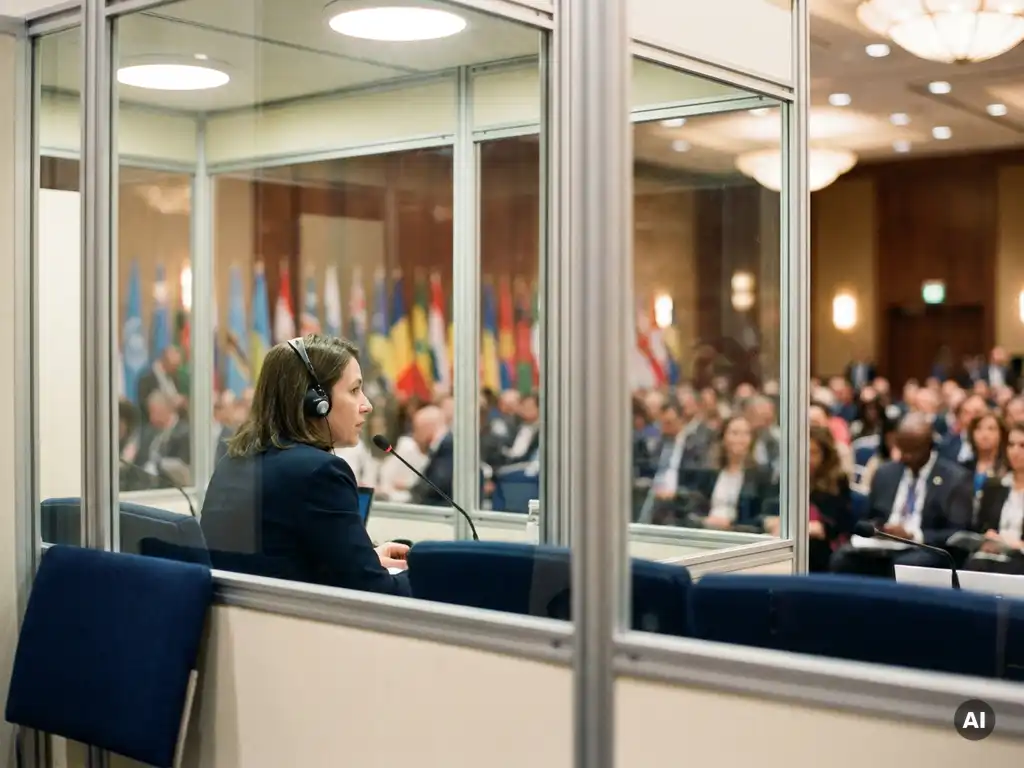
Booking simultaneous interpreters for an international conference is one of those tasks that looks straightforward until you are deep in the logistics. Unlike consecutive interpretation, simultaneous interpretation runs in real time, meaning your interpreters, equipment, and briefing materials all need to be perfectly aligned before the first delegate takes their seat. Getting this right is what separates a smooth multilingual conference from one where half the room is straining to follow along.
This guide walks you through every stage of the process, from gathering your requirements to managing interpreters on the day. Follow these steps and you will have a professional, seamless interpretation setup ready for your international conference.
What you need before contacting an interpreter agency
Before you pick up the phone or send your first enquiry, gather the core information that every reputable agency will ask for. Going in prepared saves time, prevents miscommunication, and helps you get accurate quotes rather than vague estimates.
- Language pairs: List every source language and every target language your delegates will need. Be specific, for example, Dutch to English and English to French are two separate pairs requiring separate interpreter teams.
- Number of delegates per language: Agencies and AV suppliers need this to size the receiver equipment correctly.
- Conference dates, duration, and daily schedule: Simultaneous interpreters typically work in pairs and rotate every 20 to 30 minutes. Full-day events require more interpreter hours than half-day sessions.
- Venue location and format: In-person, hybrid, and fully remote conferences each require different technical setups.
- Subject matter: Highly technical topics such as medical, legal, or financial content require interpreters with specialist knowledge in that field.
With this information in hand, you are ready to approach agencies with a complete brief rather than a rough idea. You will also find it much easier to compare quotes on a like-for-like basis.
Find and vet qualified simultaneous interpreters
Simultaneous interpretation is a highly demanding skill, and not every bilingual professional is qualified to do it. When searching for conference interpretation services, focus your search on agencies affiliated with professional bodies such as AIIC (the International Association of Conference Interpreters), which sets rigorous standards for training and professional conduct.
- Search for agencies that specifically list simultaneous interpretation as a core service, not just translation or consecutive interpretation.
- Ask whether interpreters are accredited or have verifiable conference experience in your subject area.
- Request references from comparable events, particularly those with a similar delegate size, language combination, or industry focus.
- Confirm whether the agency supplies interpreters as employees or freelancers, and ask how they quality-check their roster.
- Ask explicitly whether they can provide a backup interpreter in case of illness or emergency on the day.
Once you have shortlisted two or three agencies, compare their proposals carefully. Look beyond the headline fee and check what is included: preparation time, travel costs, and whether technical support is bundled or billed separately. For MICE events with multiple language streams, a specialist agency with multilingual event experience will almost always outperform a general translation provider.
Plan your interpretation booths and AV equipment
Simultaneous interpretation requires dedicated physical or virtual infrastructure. This is the area where planning errors most often surface on the day, so give it serious attention during the booking phase.
Booth requirements for in-person events
ISO-compliant interpretation booths are the professional standard for in-person conferences. Each booth houses a team of two interpreters per language and must meet specific size, soundproofing, and visibility requirements so interpreters can see the speaker and any presentation materials clearly.
- Confirm with your venue whether fixed booths are installed or whether temporary booths need to be hired and installed.
- Arrange a site visit with your AV supplier so booth placement, sightlines, and cable routing can be confirmed in advance.
- Ensure each booth has a monitor feed showing presentation slides and a direct audio feed from the speaker system.
Receiver units and delegate equipment
Every delegate who needs interpretation in their language requires a wireless receiver unit and earpiece. Work with your AV supplier to calculate the total number of units needed, add a buffer of around ten percent for replacements, and confirm that units are charged and tested before doors open.
For hybrid or fully remote conferences, the setup shifts to a remote simultaneous interpretation (RSI) platform. These cloud-based tools allow interpreters to work from a remote hub or home studio while delegates select their language channel through a browser or app. Confirm that your RSI platform integrates with your conference streaming software before the event.
Brief your interpreters on conference content
Even the most experienced simultaneous interpreter performs significantly better when they have been properly briefed. Send materials as early as possible, ideally two weeks before the event, so interpreters have time to prepare terminology and ask questions.
- Share the full conference agenda, including session titles, speaker names, and the order of presentations.
- Provide speaker presentations, scripts, or talking points in advance. Even draft versions are useful.
- Supply a glossary of technical, brand-specific, or industry terms that will appear frequently. If your conference involves product names, acronyms, or regulatory terminology, list them with their correct translations where possible.
- Arrange a pre-event call between interpreters and key speakers, particularly for keynotes or complex technical sessions.
Interpreters who have reviewed your materials will produce cleaner, faster output with fewer hesitations. This directly improves the experience for every delegate listening on a receiver. Skipping the briefing phase is one of the most common and avoidable mistakes in international conference interpreting.
Coordinate interpreters on the day of the event
On the day itself, your goal is to eliminate surprises. Interpreters should arrive early enough to test equipment, review any last-minute changes to the agenda, and meet the AV technician who will be their primary point of contact throughout the event.
- Schedule an interpreter arrival time at least 60 to 90 minutes before the first session begins.
- Run a full audio and booth test with the AV team before delegates enter the room.
- Assign a dedicated conference liaison who can relay real-time changes, such as speaker substitutions or agenda adjustments, directly to the interpreter team.
- Confirm the rotation schedule with each interpreter pair so both members know when they are active and when they are on standby.
- Provide interpreters with water, and ensure they have a clear sightline to a clock or timer so they can manage their own rotation without distraction.
During the event, keep the liaison available and reachable. If a speaker goes off-script, uses unexpected technical language, or speaks significantly faster than normal, the interpreter team needs to flag this quickly. A well-coordinated day-of-event process is what transforms good simultaneous interpretation booking into a truly seamless multilingual conference experience.
How GO DMC helps with international conference interpretation
Managing simultaneous interpretation logistics alongside every other element of an international conference is a significant undertaking. At GO DMC, we handle this complexity on your behalf, drawing on over 35 years of experience organizing high-profile MICE events across the Netherlands and beyond.
When you work with us, we take care of the full interpretation setup so you can focus on your content and your delegates:
- Sourcing and vetting qualified simultaneous interpreters with the right language combinations and subject expertise
- Coordinating ISO-compliant interpretation booths, AV equipment, and receiver systems with our trusted supplier network
- Managing interpreter briefings, pre-event calls, and materials distribution
- Providing on-site coordination and a dedicated event liaison throughout your conference
- Supporting hybrid and remote interpretation setups for international delegate audiences
Whether you are organizing a board-level executive summit, a large-scale industry congress, or a multilingual product launch, our team knows how to make every language stream work flawlessly. Get in touch with our team to discuss your conference requirements, and we will put together a tailored proposal for you.