
Planning a 200-person conference is already a significant undertaking. When you are deciding between two destinations, the Netherlands and Germany, the cost comparison adds another layer of complexity. Venue rates, accommodation blocks, ground transport, catering standards, and local service fees all vary meaningfully between the two countries, and the differences can run into tens of thousands of euros depending on your city choices and event format.
This guide walks you through a practical, step-by-step process to build a reliable cost comparison so you can make a confident, data-backed decision before committing your budget. Follow each step in order and you will have a structured side-by-side picture of both destinations by the end.
Gather your baseline cost inputs first
Before you can compare anything, you need to define what you are actually comparing. A 200-person conference in Amsterdam is not the same event as a 200-person conference in Frankfurt, even if the agenda is identical. Establish your event parameters clearly so every cost you gather is apples-to-apples.
Start by locking in the following variables for both destinations:
- Event duration (number of conference days plus arrival and departure days)
- Room block size (typically 80 to 100 percent of attendees staying on-site or nearby)
- Session format (plenary only, breakout rooms, hybrid streaming requirements)
- Catering scope (coffee breaks, lunches, gala dinner, welcome drinks)
Once these are fixed, request quotes using identical briefs from suppliers in both countries. This is the most common place planners lose accuracy: they get a quote for a full-day conference package in Rotterdam and a room-hire-only quote in Düsseldorf, then compare them directly. Standardize your brief first, then gather numbers.
Calculate venue and AV costs for both destinations
Venue hire is typically the single largest line item in a conference budget, and the gap between the Netherlands and Germany can be significant depending on city tier. Major Dutch conference cities such as Amsterdam, The Hague, and Rotterdam tend to command premium rates for purpose-built conference centers, while German second-tier cities like Leipzig, Hanover, or Stuttgart can offer competitive alternatives to Frankfurt or Munich.
When gathering venue quotes, request itemized breakdowns that separate:
- Room hire for the main plenary space (capacity for 200 with staging)
- Breakout room hire if your agenda requires smaller sessions
- Built-in AV packages versus bring-your-own-supplier policies
- Technical staffing fees, rigging costs, and internet bandwidth charges
AV is where hidden costs frequently appear. Many venues in both countries charge separately for high-speed dedicated internet, LED screens, simultaneous interpretation booths, and hybrid streaming infrastructure. A venue that looks cheaper on room hire can quickly become more expensive once AV is fully scoped. Always request a fully loaded AV quote before drawing conclusions from the headline venue rate.
Compare accommodation and transport expenses
With your venue costs documented, turn to accommodation and transport, which together often represent 40 to 50 percent of total delegate spend for a multi-day conference.
For a 200-person group, you are negotiating a room block, and your leverage depends heavily on the destination’s hotel supply and demand at your chosen dates. The Netherlands has a relatively concentrated hotel market in its major cities, which means peak season (spring tulip season, summer, and major trade fair periods) can push group rates significantly higher. Germany’s hotel market is larger and more distributed, but major trade fair cities like Frankfurt, Cologne, and Hamburg experience their own demand spikes around Messe events.
For transport, compare these two cost categories side by side:
- International flight costs for your delegate origin cities (check whether your attendees are primarily European or intercontinental)
- Ground transport within the destination (airport transfers, shuttle logistics between hotel and venue, evening event transfers)
The Netherlands benefits from excellent rail connectivity, meaning delegates arriving at Amsterdam Schiphol can reach The Hague, Rotterdam, or Utrecht within 30 to 60 minutes by train. This can meaningfully reduce ground transport costs compared to destinations that require coach fleets. Germany’s rail network is similarly strong, but intercity distances between airport hubs and conference venues can be longer depending on your chosen city.
Factor in catering, local services, and hidden costs
Catering costs for 200 people across a multi-day conference are substantial, and the pricing structures differ between the two countries. Dutch venues and catering suppliers generally price per person per day with tiered packages, while German venues often use a similar model but with different VAT treatment and service charge conventions.
Beyond catering, build the following into your cost model before finalizing any comparison:
- Local DMC service fees (destination management, supplier coordination, on-site management)
- Permits and regulatory requirements (some Dutch venues and public spaces require event permits with associated fees)
- Currency and payment terms (both countries use the euro, which removes exchange rate risk entirely)
- Contingency buffer (industry experience suggests reserving 10 to 15 percent of total budget for unplanned costs)
One area that catches planners off guard is the cost of local staffing and event support. The Netherlands has strong labor cost standards, and experienced bilingual event staff command competitive day rates. Germany is similar, though rates vary by region. Factor these into your model explicitly rather than treating them as incidental expenses.
Build a side-by-side cost comparison matrix
With all your inputs gathered, the final step is to organize everything into a structured comparison matrix. This document becomes your decision-making tool and your internal approval document if budget sign-off is required.
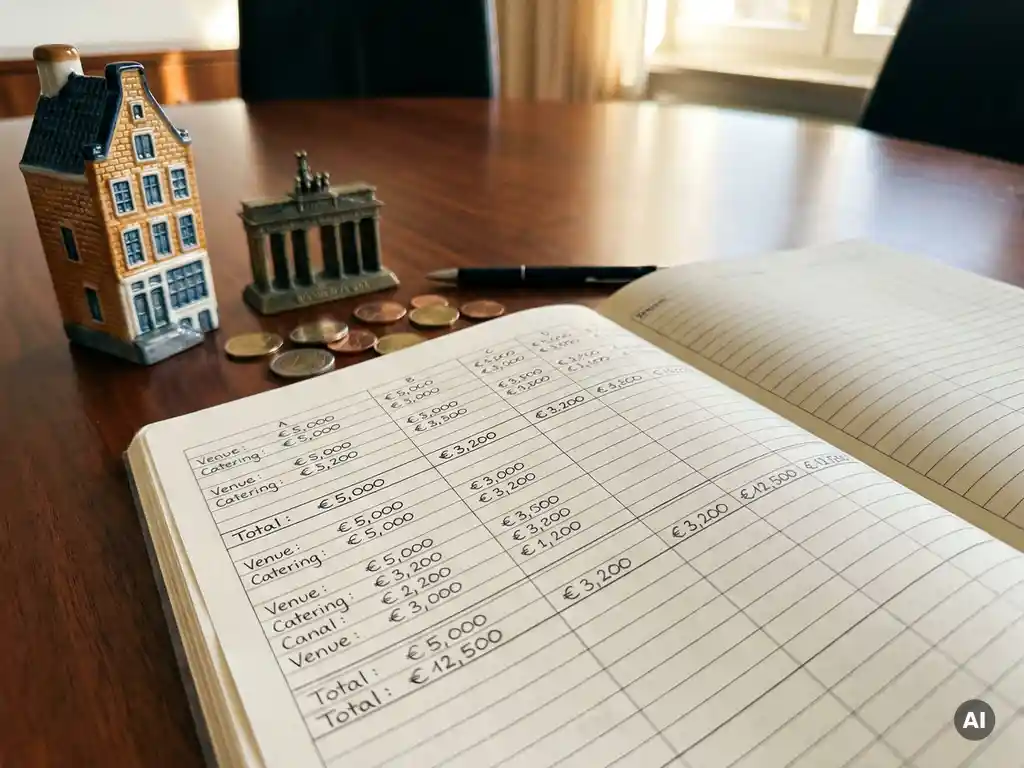
Structure your matrix with cost categories as rows and the two destination options as columns. For each category, record the low estimate, high estimate, and your working assumption. This gives decision-makers a realistic range rather than a single number that may prove optimistic.
Your matrix rows should follow this sequence:
- Venue hire (full event duration, all spaces)
- AV and technical production
- Accommodation (room block, estimated pick-up rate)
- Ground transport (transfers, shuttles, evening logistics)
- Catering (all meals, breaks, and evening functions)
- Local services and DMC fees
- Contingency reserve
Once you have totals for both destinations, calculate the cost per delegate by dividing each total by 200. This per-head figure is often the most useful number for internal presentations because it frames the investment in human terms rather than abstract totals. A destination that costs €15,000 more in total may cost only €75 more per person, which is a very different conversation than the headline number suggests.
Review your matrix for gaps before presenting it. If any row shows a significant difference between destinations, trace it back to the source quote and verify it reflects identical scope. A reliable comparison matrix is only as good as the consistency of the inputs behind it.
How GO DMC helps with destination cost comparisons
Building an accurate cost comparison between two international destinations takes time, supplier relationships, and local knowledge that most internal planning teams simply do not have on hand. That is where we come in. At GO DMC, we have spent more than 35 years developing deep expertise across the Netherlands’ major cities and regions, and we bring that knowledge directly to your budget planning process.
When you work with us on a destination comparison, we provide:
- Pre-negotiated supplier relationships across Amsterdam, Rotterdam, The Hague, Utrecht, and Maastricht that give you realistic, market-accurate quotes from day one
- Full scope management so your comparison brief is consistent across every venue, hotel, and service provider we approach on your behalf
- On-the-ground insight into seasonal pricing, permit requirements, and local cost variables that rarely appear in standard supplier quotes
- A structured cost model delivered as a clear decision-ready document for your stakeholders
Whether you are weighing the Netherlands against Germany or comparing cities within the Dutch market, our DMC services give you the clarity and confidence to commit to a destination with your budget fully understood. Reach out to our team and let us build your cost comparison together.